How to grow beautiful roses

cropped-img_1570.jpg

Following the basic rose culture, you’ll be on your way to have beautiful roses in your garden:

  • Buy only strong healthy plants. Buy your roses from reliable sources.
  • Rose needs a minimum of 4 hours of sunlight, lots of drainage and away from tree roots.
  • Before you start planting, do a soil test. The ideal pH for roses is 6.0 – 6.5.
  • Dig a hole at least 18” deep and 18” in diameter. Mix soil 1/3 organic matter (peat moss) with 2/3 soil from the hole. Put a handful of Epsom salt, a banana peel and a handful of superphospate in the hole.
  • Space rose bushes at least 3 ft apart for good air circulation for hybrid teas and floribundas. English roses and other shrub roses should be spaced at least 4 ft apart.
  • Roses need about 1” to 1 ½” of water a week so water more often during the hot spell in the summer. If rain is lacking, water twice a week. Reduce watering in the fall but do not let your rose bushes enter winter under stressful condition.
  • Mulch is important since it keeps out weeds, conserves moisture and protects the roots from fluctuations in temperature.
  • Rose is a heavy feeder. Use plenty of organic fertilizer. Supplement with chemical fertilizer. Six weeks before the first fall frost, stop the fertilization program.
  • Deadhead as soon as the bloom is finished.
  • Pruning controls the size and shape and keeps the roses blooming all season long.
  • Spray horticultural oil in late winter thru to late spring to keep blackspot in check.
  • Keep the rose beds clean to discourage diseases and insects.
  • To get immediate answers to rose questions, join the Facebook group, Rose Gardening World, which I created on Oct. 18, 2011 and has grown to 5,500 members and counting where members share their rose photos and help each other with rose problems.


Until Next Time. Stop and Smell the Roses.

Rosalinda


Limited Time Offer for Stop and Smell the Roses – One Week Only


Stop and Smell the Roses 3D

Starting Monday, July 16, 2018 at 8:00 a.m. PDT and ends on Sunday, July 22, 2018 at 8:00 a.m. PDT when it goes back to its regular price of $4.99. you can order the kindle copy of Stop and Smell the Roses for $1.99 at Amazon.com. Click here to buy now.


Feeling stressed out? Stop and smell the roses and 100 other tips in a new motivational book to help you get inspired to make positive changes in your lives to make you happy, healthy and successful. In a frenetic world we live in, we find ourselves overwhelmed, overworked and stressed out. Isn’t it time to change our bad habits? Most of our health problems are due to our unhealthy lifestyle. Studies show that stressful living causes health problems.


Inspire yourself into a healthy lifestyle! Stop and Smell the Roses!


Do you know that roses have curative powers? In the olden days, roses were used to make all sorts of medicinal potions to cure maladies and drive away bad spirits. A bouquet of roses uplifts the spirits any day of the year. Even a single rose in a room will liven it up on dreary days. When we are in distress, a rose will cheer us up.


“Stop and Smell the Roses” includes some of the roses I grow in my garden. There are 33 roses featured in the book in full color. If you are unable to visit a rose garden, this is the next best thing.


Find out how you can improve your well-being by following simple tips for stress-free living. I invite you to my garden. So take a break and stop and smell the roses.


Take advantage of the Limited Time Offer. Get your copy today!


Until next time. Stop and smell the roses.

Rosalinda Morgan


A Rose (Rosa banksiae) and a Tip for a Happy, Healthy and Successful Living


Rosa Banksiae

Class: Rose Species

Syns:   R. banksiana, Banksian rose, Banks’ Rose, Lady Banks’

Cultivated since 1796


Rosa banksiae is one of the best shrubs for a wall and in a few years will reach the top of most houses. It produces an abundance of pretty small roses with the sweetest fragrance you can imagine. The flowers are borne on last year’s wood and so it is well-advised not to prune in the spring. Only dead or useless branches have to be trimmed. The date of introduction is not known but the double white form was first described in the Botanical Magazine for 1818 as Lady Banks’ Rose and one of the sweetest of roses. It has also been known as a native of China and had been introduced in 1807 by William Kerr. The double yellow was introduced in 1824.


Definitely not for the small property, this vigorous species rose offers a spectacular spring show in warm-climate gardens that can accommodate its rampant growth habit. There are four different forms of R. banksiae, varying by flower color and flower form.

·        R. banksiae normalis is considered to be the “wild” form, with single white flowers.

·        R. banksiae banksiae (also known as ‘Banksiae Alba’, R. banksiae alba, R.banksiae alba-plena, White Banksia, or White Lady Banks’ Rose) offers exceptionally fragrant, double white flowers.

·        R. banksiae lutea (R. banksiae lutea-plena, Yellow Lady Banks’ Rose) is the most well-known form of Rosa banksiae in cultivation with small, fully double, bright yellow flowers that come in clusters. They are only slightly fragrant.

·        R. Banksiae lutescens has single light yellow blooms.


All four have small, oval buds that open to clustered, 1-inch wide, rosette-form flowers, usually blooming in early or midspring to late spring. Slender, thornless canes carry semi-evergreen to evergreen, shiny, dark green leaves with narrow leaflets. They are rarely bothered by diseases.


All four forms of this specie rose have a vigorous, rambling habit and can grow up to 30 ft, so they’re usually used as 20 to 30-foot climbers. They need a sturdy support, such as a well-built pergola or arbor; they also like to scramble into trees. It is a great rose for zone 8 to 10.


I saw Rosa banksiae in Charleston, SC on my first visit there in 1989. We went on a House and Garden Tour and at one of the gardens we visited, ‘Yellow Lady Banks’ was growing almost to the roof of the house against the wall. We wandered along some tiny street and I saw ‘Yellow Lady Banks’ rose by the gate and I took the above photo. Fast forward to 2011 – when I joined the Charleston Lowcountry Rose Society, I discovered the owner of that rose is one of our members.


Tip of the Day – Learn to be cheerful even if you don’t feel like it.


Until next time. Stop and smell the roses.


Rosalinda


A Rose (Peggy Martin) and a Tip for a Happy, Healthy and Successful Living

Peggy Martin

Photo Credit – Chamblee’s Rose Nurseries


The Peggy Martin Rose symbolizes the tenacious survival skills of the rose.  One of only two plants in the garden of its owner, Peggy Martin, to remain alive after immersion in 20 feet of water due to Hurricane Katrina.  It is a ‘found’ rambler, virtually thornless, with a small prickle at the beginning of leaf growth, a profusion of dark pink blooms remontant after maturity from spring to hard frost.  The entire story of its selection as a symbol of garden rebirth can be found in an article by Dr. William Welch  at http://aggie-horticulture.tamu.edu/southerngarden/PeggyMartinrose.html.


The Peggy Martin Rose is very hardy, can survive a below zero degree temperature and is disease-resistant, fast growing, and after established will bloom again in the Fall along with intermittent flower flushes through the year. Every year in spring, The Peggy Martin Rose will show a spectacular display of flower explosion bigger and more spectacular than the year before.  In the south, it stops blooming in the hottest months of Summer but up north it will bloom continuously.  The Peggy Martin Rose is a very vigorous plant so give it room to grow to show its full potential.  It is great planted on a garden entrance arbor or structure.  It is not a once bloomer!!!

TIP OF THE DAY:   Live your life so that your epitaph could read “No regrets”.


Until next time. Stop and Smell the Roses

Rosalinda


Breaking News: Stop and Smell the Roses

Stop and Smell the Roses Front Cover


Feeling stressed out lately? It is time to change our bad habits.

In a world buzzing with frenetic activities, we find ourselves as busy as ever. No wonder we are all stressed out. Most of our health problems are due to our unhealthy lifestyle. Studies show that stressful living causes health problems. Find out how we can improve our well-being by following simple tips for stress-free living in a new book titled “Stop and Smell the Roses”. It is a rose book with motivational twist or rather a motivational book with a rose twist. 

Inspire yourself into a healthy lifestyle! Stop and Smell the Roses!

Do you know that roses have curative powers? In the olden days, roses were used to make all sorts of medicinal potions to cure maladies and drive away bad spirits. A bouquet of roses uplifts the spirits any day of the year. Even a single rose in a room will liven it up on dreary days. When we are in distress, a rose will cheer us up.

“Stop and Smell the Roses” includes some of the roses I grow in my garden. There are 33 roses featured in the book. There are 90+ rose-related photos in the book, all in full color. If you can’t go to a rose garden, the next best thing is to curl up in a comfortable chair and read “Stop and Smell the Roses”. In addition to all the rose photos, there are 101 motivational tips that will inspire you to make positive changes in your lives to make you happy, healthy and successful.

So take a break and stop and smell the roses.

“Stop and Smell the Roses” is now available on Kindle and Paperback at Amazon. Here is the link: at https://www.amazon.com/Rosalinda-Morgan/e/B00C03KL72.

Order your copy today and spread the word. Let’s enjoy a stress-free living. Thank you.  

Until next time. Stop and Smell the Roses.
Rosalinda


A Rose (Rosa Foetida Bicolor) and a Tip for a Happy, Healthy and Successful Living

Austrian Copper

Class:   Species

Date of Introduction:   Before 1590

Common Name:   ‘Austrian Copper’


Not until late nineteenth century when a French breeder named Pernet-Ducher introduced ‘Rosa foetida persiana’ as a pollen parent to breed the first yellow and orange colored large-flowered rose called ‘Soleil d’Or’ did gardeners take notice of this rose coloration. That was a significant event.

‘Austrian Copper’ is a sport of ‘Rosa foetida’ that has been cultivated as early as the 12th century in the Arab world. It is native to Iran and Afghanistan and it is not Austrian in spite of its name. It has single blossoms, 2” in diameter of bright coppery red with yellow reverse and bright yellow stamens. Its color is eye catching. The rose is so beautiful when the sun is shining behind it. It gives such luminescence that’s so magnificent. The petals are very fragile and heavy wind will knock the petals off easily. It is not fussy about soil and can be grown in poor soil as long as there is good drainage. It is winter hardy and requires little care. It is a vigorous grower and it suckers. It can take over a large area if not controlled. It has long, arching canes that can reach up to 8 ft. and can be trained to climb trellis, pergola, fence or even trees. It only takes a couple of years for the plant to reach 6 to 7 ft. high and can grow as high as 20 ft. When trained horizontally, they develop lateral shoots which will be covered with flowers the following season. Flowers arise from old wood so pruning should be done after it finishes flowering. It is a once bloomer, in late spring or early summer for 2 to 3 weeks.

Most often, ‘Austrian Copper’ will sport back to ‘Rosa foetida’. It is a stunning plant and every garden should have it. The only downside is it is susceptible to black spot so separate it from the rest of your roses. For rose exhibitor, this rose is eligible for Genesis Award.


Tip of the Day:   Eat your veggies. They are good for you. 


Until next time. Stop and smell the roses.


Rosalinda

A Rose (Bow Bells) and a Tip for a Happy, Healthy and Successful Living

IMG_2937


Class:   Shrub

Date of Introduction:   1991

Hybridizer:   David Austin

Parentage:   [(‘Chaucer’ x ‘Conrad Ferdinand Meyer) x Graham Thomas]

Registration Name:  AUSbells


In my garden, I am always surprised that in spite of the weather, heat or cold, some roses did remarkably well when most of the others were stressed out. One of them that’s a survivor is ‘Bow Bells’, a great David Austin Rose. ‘Bow Bells’ has a rich deep-pink high -centered blooms with 15 to 25 petals and about 2.75” in diameter that are produced in clusters. The blooms stand out well against the dark green foliage. It will even grow in the semi-shade area of your garden. If you want constant color and easy care rose in the garden, this rose is a good candidate. ‘Bow Bells’ is not an exhibition rose but a very good garden rose that’s superbly healthy and blooms non-stop even in the heat of the summer.

I had one in New York in a semi-shaded spot and it bloomed constantly. In August when every rose in my garden took a breather, this rose was still blooming its head off. In Charleston, I planted one on its own root and it grew up to six feet tall in its first year. I cut it back after each flush of blooms otherwise it gets too tall. It can grow to 8’ tall by 4’ wide. While ‘Scentimental’ which grows next to it was completely defoliated during the summer, ‘Bow Bells’ green foliage is intact, no blackspot. I don’t spray and have only used one application of Bayers All-In-One for the season.

Few roses will thrive in partly shaded sections of the garden. ‘Gruss an Aachen’ a floribunda and ‘Bow Bells’, a David Austin Rose will do quite well in dappled shade. ‘Bow Bells continuously blooms in the shade. When some of my roses take a break in the summer, my two Bow Bells are still blooming their hearts out.

Tip of the day – Become the most positive and enthusiastic person you know. 


A Rose (Iceberg) and a Tip for a Happy, Healthy and Successful Living


Iceberg 4
Photo Credit – Flowers My Inspiration


Class:   Floribunda

Parentage:   ‘Robinhood’ x ‘Virgo’

Date of Introduction:   1958

Hybridizer:   Reimer Kordes

Registration Code:   KORbin

Syns:   ‘Fee des Neiges’, ‘Schneewittchen’


I first saw ‘Iceberg’, a white modern, cluster-flowered rose (floribunda) in California about fifteen years ago. I was amazed then at how popular ‘Iceberg’ roses was in Southern California at that time in spite of the rose being 40+ years already since it was first introduced by Reimer Kordes. They were everywhere. We saw a lot of them at private gardens and even at the wineries in Temecula.


iceberg.2


The flowers are semi-double, 20-25 petals and well formed, pure white with occasional pinkish tints in the bud state, especially in early spring and autumn when the nights are cold and damp. The blooms are produced continuously in clusters of up to 15 per spray, long lasting, both on the bush or as a cut flower. They have a moderate but not overpowering rose fragrance. ‘Iceberg’ can be used as a bedding plant for massed display which was very effective as we saw them in California. ‘Iceberg’ is almost entirely resistant to mildew and suffers only mildly from blackspot. All in all, ‘Iceberg’ is still the best and most popular white floribunda today.


‘Climbing Iceberg’ (syn. ‘Climbing Fee des Neiges’), introduced in 1968, is never without bloom, is a disease-resistant, healthy, robust plant. It is not too rampant and can be used to cover small fences or garden structures and even entwine around veranda posts.


Awards:

National Rose Society Gold Medal 1958

Baden-Baden Gold Medal 1958

World’s Favorite Rose 1983

Royal Horticultural Society Award of Garden Merit 1993.


Tip #42 – Make physical fitness a priority. Stop being a couch potato. 


Until Next Time. Stop and Smell the Roses

Rosalinda


A Rose (Sally Holmes) and a Tip for a Happy, Healthy and Successful Living

IMG_2231

Name: Sally Holmes’

Class: Shrub

Parentage: ‘Ballerina’ x ‘Ivory Fashion’

Hybridizer: Robert A. Holmes

Introduced by: Fryer’s Roses in U.K.


‘Sally Holmes’ rose was introduced in 1976 and is a cross between ‘Ballerina’, a hybrid musk and ‘Ivory Fashion’, a Floribunda. It is a single rose of five petals with bloom size of 3” to 4” across with yellow stamens. ‘Sally Holmes’ rose is classified as a shrub but it is so vigorous, it can easily be grown as a climber.

I have seen ‘Sally Holmes’ rose at a friend’s front yard and it is quite a sight. The rose grows all the way to the second floor. It has to be tied strongly to the wall for support. It can grown from 6’ as a shrub and up to 12’ as a climber with almost thornless canes. ‘Sally Holmes’ rose is considered a white shrub rose but her tight buds will appear light apricot maturing to white with a tint of pink at the edges. Foliage is glossy and very disease-resistant. It is also shade tolerant. It has a sweet fragrance.

If you are an exhibitor, it constantly wins awards at the show table. ‘Sally Holmes’ rose is truly an spectacular rose.

Awards:

Baden-Baden Gold Medal 1960

Glasgow – Fragrance 1993

Portland – Gold Medal 1996


Tip #41 – Judge your success by the degree that you’re enjoying peace, health, and love.


Until next time. Stop and smell the roses.

Rosalinda

A Rose (Easy Going) and a Tip for a Healthy, Happy and Successful Living


Easy Going by Peggy Grimsley

Class:   Floribunda

Date of Introduction:   1999

Hybridizer:   Harkness, Britain, 1999

Registration Name:   ‘HARflow’


Easy Going is a sport of Livin’ Easy and has the same characteristics as its parent except for the color which is golden peachy yellow with a hint of pink instead of orange and yellow. This floribunda has a rating of 8.0 at 2018 American Rose Society Handbook for Selecting Roses. Bloom size is 3 to 4 inches across. Easy Going blooms profusely and the blooms come in clusters of 3 to 7 blooms and have 26-30 thick, wavy petals complemented by healthy dark green, shiny foliage. Easy going has a sweet, honey scent. Usually its habit is short, about two feet tall and rounded. However, it can reach almost four feet tall.

Easy Going was one of the healthiest roses in my old garden. Easy Going was amazing that it got so healthy in its location where previous roses planted in the same spot always died. It has won an All-American Rose Selections Award in 1996 and Royal National Rose Society Gold Medal in 1990. If possible, plant Easy Going in group of 3 or 5 for great impact. Blue flower plants are good companion plants.


Tip #40 – Drink eight glasses of water every day to flush out the toxins in your body.


Until Next time. Stop and Smell the Roses.

Rosalinda


A Rose (Tournament of Roses) and a Tip for a Happy, Healthy and Successful Living

Tournament of Roses

Class:   Grandiflora

Parentage:   ‘Impatient’ x seedling

Hybridizer – William Warriner

Date of Introduction:   1988

This pink grandiflora of 25 to 30 petals is aptly named in honor of the Tournament of Roses, the famous parade of all times held annually on New Year’s Day in Pasadena, California. Tournament of Roses is an AARS selection in 1989. It is sometimes classified as a hybrid tea because of the shape of its flowers although it is really a grandiflora.

Bloom size is 3.5 inches on long stem with light fragrance. The blooms have all shades of pink within them – deep pink in the center, pale pink at the edges, darker pink on the outside. Tournament of Roses blooms profusely in clusters of 5 to 7 blooms like a floribunda on a medium upright bush with glossy dark green leaves and large prickles. It is highly disease-resistant and easy to grow. It produces blooms well into the winter.  Tournament of Roses is both an excellent rose for exhibition and garden rose with plenty of blooms to enjoy outside in the garden and to take indoors to enjoy.


Tip #39 – Don’t accept “good enough” as good enough.


Until Next time. Stop and Smell the Roses.
 Rosalinda


A Rose (Signature) and a Tip for a Happy, Healthy and Successful Living


Signature
Photo Credit – Bob Sabin


Class:   Hybrid Tea

Cultivar Name:   JACnor

Parentage:   ‘Honor’ x ‘First Federal’s Renaissance

Year of Introduction:   1996

Hybridizer:   William Warriner


‘Signature’ is most definitely a rose lover’s Rose. It was Jackson and Perkins Rose of the Year in 1996. Its consistent winning performance on the exhibition floor makes it a great choice for gardeners looking to show their roses and win. It is one of the top ten exhibition roses in the country since its introduction in 1996.

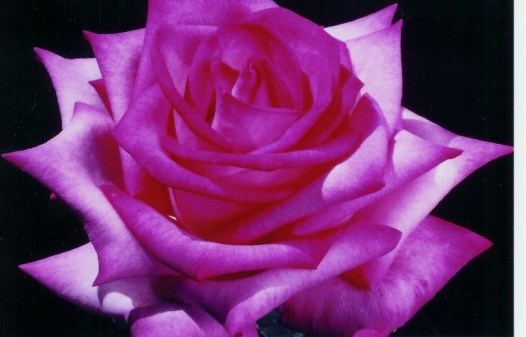
‘Signature’ is remarkable for the sheer size and intense coloration of its blooms with a hot pink base tone and cream-streaked centers on satiny petals that create a fantastic glowing effect as if the bloom was lit from within. Add to this the rose’s vigorous, tall, upright habit and great disease resistance, and it is easy to see why this rose earns the name ‘Signature’.

Bred as an exhibition rose, this prize-winner is a real standout in the vase! Borne mostly singly, these perfectly formed blooms arrive in waves all summer long. They open from long, pointed buds to form a huge, high-centered perfectly formed blooms, 5 to 6 inches in diameter, 30 to 40 petals count on a long stem about 18 inches long. Upright and vigorous, the plant will swiftly reach 4 to 5 feet tall and wide. ‘Signature’ offers clean, thick leathery, dark green foliage with superb disease resistance to mildew. If you’re looking for a carefree hybrid tea with some of the most jaw-dropping blooms ever seen and fruity fragrance, then introduce your garden to ‘Signature’.

Because it grows all the way down to the ground, it eliminates the need for foreground plantings. Plant ‘Signature’ in a well-drained sunny spot. It tolerates most soil type as long as they stay evenly moist but not wet. Because ‘Signature’ is not very cold hardy, it is better suited growing in the ground than in containers. If grown in containers, it requires winter protection. Protection from spring frosts is also recommended. Plant it in the garden in a group of three with some blue perennial like salvia or dephinium and the effect is quite dazzling.

Tip #38 – Everyday look for ways to improve the way you do your job.


Until Next time. Stop and Smell the Roses.

Rosalinda